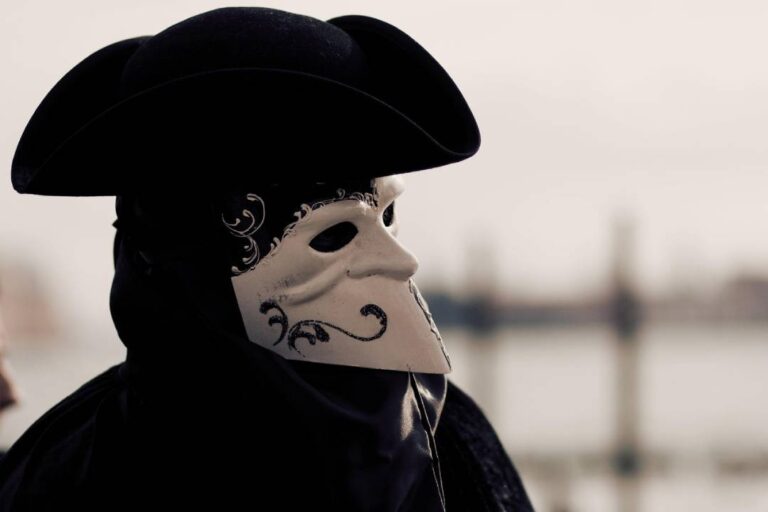


The Venice Carnival, one of Italy’s most emblematic and anticipated events, is known for its unique atmosphere, blending mystery, elegance, and tradition. With origins dating back to Ancient Rome, the festival has evolved over the centuries, becoming a global icon of celebration and culture.
Roman Origins and the Evolution of Carnival
The history of the Venice Carnival begins with ancient Roman traditions, specifically the Saturnalia festivals, dedicated to the god Saturn, where social norms were reversed, and freedom of expression was encouraged. This spirit of liberation and festivity was absorbed into medieval Venetian celebrations, which became associated with Carnival days.
These festivities took place at the end of December, marking the winter solstice and promoting the inversion of social roles, where slaves and masters exchanged positions. Much like today’s Carnival, the Saturnalia involved banquets, dances, and the use of masks to conceal identities, allowing for a freedom of behavior without social repercussions.
During the Middle Ages, Venice adopted these traditions, adapting them to the Christian context as a form of celebration before the start of Lent. The first official record of the Venice Carnival dates back to 1296 when the Senate of the Most Serene Republic of Venice declared the day before Lent a public holiday. From then on, Carnival evolved into a grand event, reflecting the splendor and wealth of the Venetian Republic.
However, it was only in the 11th century that the event began to take on a more structured form. During this period, celebrations started occurring around January 25th, the feast of Saint Paul, with festivities lasting for days.
Over time, the Venice Carnival became one of the city’s most significant social events, especially during the Venetian Republic, when the nobility and merchants from the city’s leading families participated in luxurious parties and masked balls, where identities were concealed with the famous masks.
The Golden Age of the Venetian Carnival
The Venice Carnival reached its peak in the 18th century when the city was one of Europe’s major cultural and economic centers. During this period, the event was not only a time of revelry but also a means of escaping the strict social norms of the era. Masks and costumes allowed people to move freely among different social classes, fostering an anonymity that encouraged romantic encounters, gambling, and even forbidden political discussions.
Giacomo Casanova, the famous Venetian adventurer and seducer, is often associated with this golden age of Carnival, taking advantage of the masks’ anonymity to engage in romantic escapades and daring exploits.
Masks: Symbols of Freedom and Mystery
Masks play a central role in the Venice Carnival. They were used to conceal participants’ identities, allowing them to act without the usual social constraints. This anonymity created a sense of freedom, where social classes mixed, generating a unique atmosphere of temporary equality. Each type of mask held a specific meaning, with some being simple and others highly elaborate, adorned with fine details and luxurious embellishments.
Types of Masks and Their Meanings
🔹 Bauta
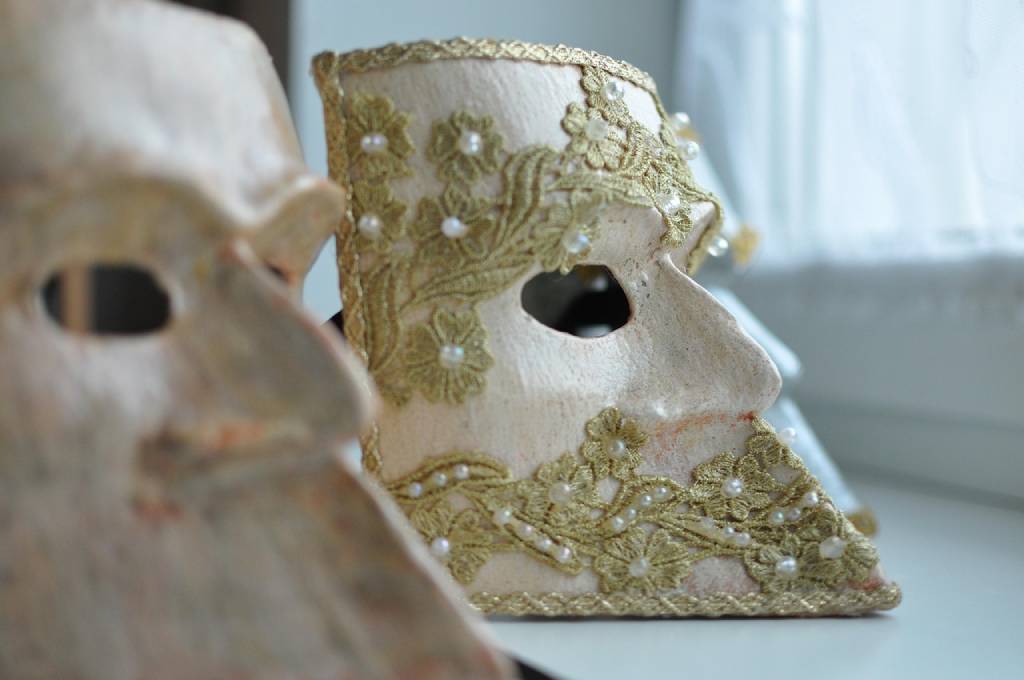
The Bauta is one of the most traditional and enigmatic masks of the Venice Carnival. It covered the entire face, with a pronounced chin that allowed the wearer to speak, eat, and drink without having to remove it. It was often worn with a black cloak (tabarro) and a tricorn hat, ensuring complete anonymity. The Bauta was popular among nobles and politicians for secret meetings.
🔹 Moretta
The Moretta was an oval mask, mainly worn by women. It covered the entire face and was held in place by a button gripped between the teeth, preventing the wearer from speaking, adding an air of mystery and female submission. This mask was popular in romantic encounters and social intrigues.
🔹 Volto (or Larva)
The Volto, also known as Larva, is a white mask covering the entire face, typically worn with a black cloak and tricorn hat. Its simplicity gave it a ghostly and anonymous appearance, making it ideal for those seeking complete privacy.
🔹 Colombina
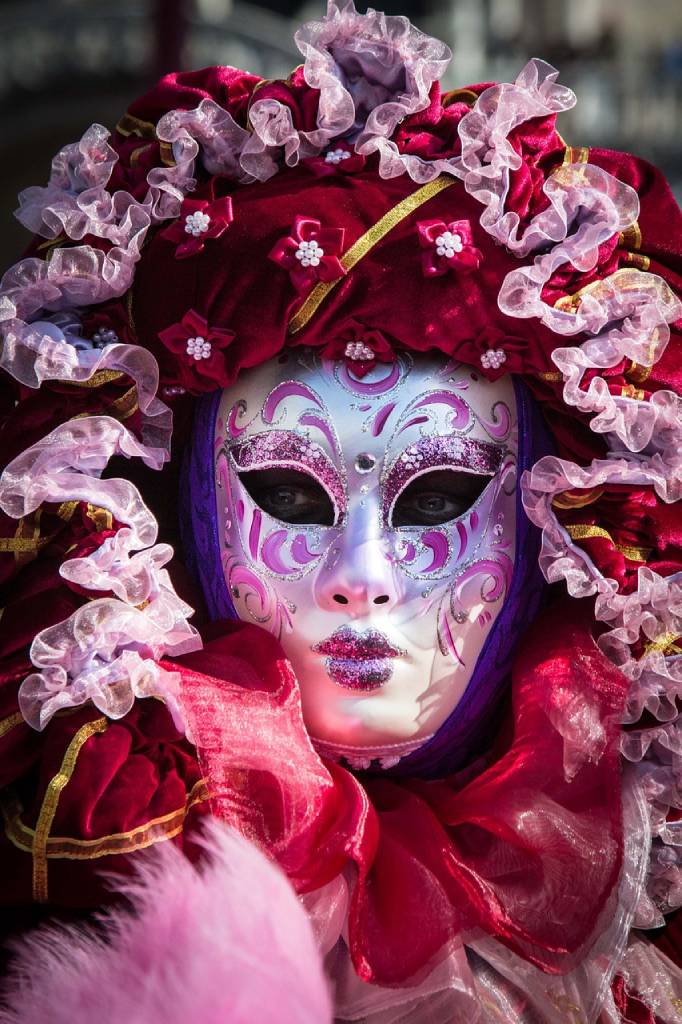
Inspired by the character from Commedia dell’Arte, the Colombina is a feminine mask covering only the eyes. Often decorated with gold, silver, and feathers, it is one of the most glamorous masks and remains popular among women today.
🔹 Arlecchino and Pantalone
These masks represent characters from Commedia dell’Arte, a form of popular Italian theater. Arlecchino is the cunning and playful servant, while Pantalone is the old miser. Their colorful masks and extravagant costumes serve as a reminder of Carnival’s theatrical origins.
Venice Carnival Traditions and Events
🎭 The Flight of the Angel (Volo dell’Angelo)
The Flight of the Angel is one of the most eagerly awaited ceremonies of the Venice Carnival. Held in Piazza San Marco, the tradition dates back to the 16th century when a young Turkish acrobat walked on a tightrope stretched between an anchored ship and the bell tower of St. Mark’s Basilica. Today, a woman dressed as an angel “flies” from the bell tower to the square, officially marking the start of the festivities.
👑 The Festa delle Marie: A Centuries-Old Tradition
The Festa delle Marie is one of the most fascinating traditions of the Venice Carnival, with deep historical roots dating back to 943 AD, though it became a formal celebration during Carnival in 1039. The origins of the festival are surrounded by mystery and multiple interpretations, but one particularly emblematic story has survived through the centuries, forming the basis of this dazzling and symbolic celebration.
🔹 The Origins of the Festival
The first reference to the Festa delle Marie is linked to the “Purification of Mary,” celebrated on February 2nd. In Venice, it was customary to bless the marriages of twelve young women, chosen from the city’s most beautiful and impoverished. This event took place at the Basilica of San Pietro di Castello, one of the oldest churches in the city, and attracted the attention of the local nobility.
The involvement of noble families was significant, as they contributed large donations to the brides’ dowries. Additionally, it was tradition for the Doge, the city’s leader, to lend valuable jewelry and ornaments from the city’s treasury to further embellish the brides. After the religious ceremony, the young women formed a procession to Piazza San Marco, accompanied by members of the aristocracy and clergy. This procession was a spectacle, not only for the beauty of the brides but also for the elaborate costumes and accessories.
⚔️ The Kidnapping of the Brides and Venice’s Victory
However, the event became notorious for a dramatic incident in 943, during the dogate of Pietro III Candiano. During the ceremony, Istrian pirates attacked and kidnapped the brides, taking them along with their precious dowries. The attack initially caused great panic, but a victorious pursuit followed. The Venetians, led by the Doge, managed to capture the pirates and rescue the young women and their belongings. To commemorate the victory, the Doge declared that the site of the attack be named “Porto delle Donzelle,” a name that remains today.
🏰 The Tradition’s Evolution and Modern Revival
The Festa delle Marie continued until 1379, when it was suppressed due to the War of Chioggia. However, its memory was never forgotten. The event was revived in 1999, approximately six centuries later, with some modifications adapted to modern times, but still preserving the essence of its origins.
Today, the Festa delle Marie remains one of the cornerstones of the Venice Carnival, keeping alive the memory of one of the city’s most unique and emblematic traditions.
🎭 Floats and Parades: The Elegance of Carnival
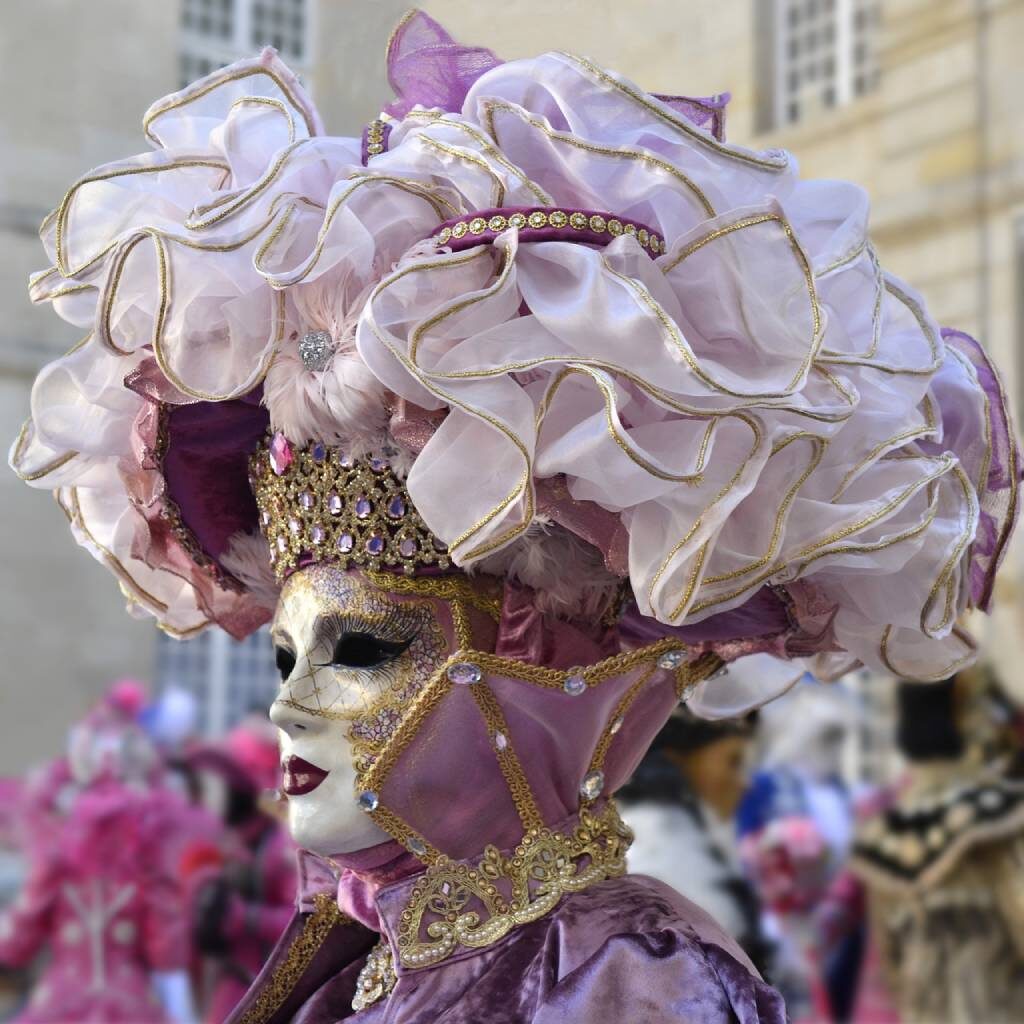
In addition to traditions like the Festa delle Marie, the Venice Carnival is also known for its parades and floats. The parades in Venice are equally impressive and unique. Participants dress in grand costumes inspired by historical and mythological figures, parading through the city streets and creating a spectacle of colors and brilliance that captivates both tourists and locals.
These parades are part of the grand celebration that takes over the city, featuring music, dance, and theater performances that transform the streets of Venice into a true stage for artistic expression.
🏛️ The Venice Carnival and Its Cultural Significance
The Venice Carnival is more than just a festival. It is a celebration of Venetian culture, history, and art. During the event, the city is filled with a unique energy, where both tourists and locals share in the joy of a tradition that blends the past with the present. The city, with its narrow streets and historic squares, becomes the perfect setting for this celebration, where history and fantasy intertwine at every corner.
The Carnival is also an opportunity for many artists, artisans, and designers to showcase their talent, creating unique masks, costumes, and accessories. Art and craftsmanship play a fundamental role, forming an essential part of the Venetian experience for both participants and spectators alike.
🍽️ Carnival Gastronomy
During Carnival, Venice is filled with traditional sweets, such as:
- Frittelle: Known as Le Fritole in the Venetian dialect, these are light, fried pastries filled with cream, raisins, or chocolate.
- Galani: Thin strips of fried dough, dusted with powdered sugar—light, crispy, and delicious.
🔗 Internal and External Links

 ✍️ Idealizadora e autora do Verament...