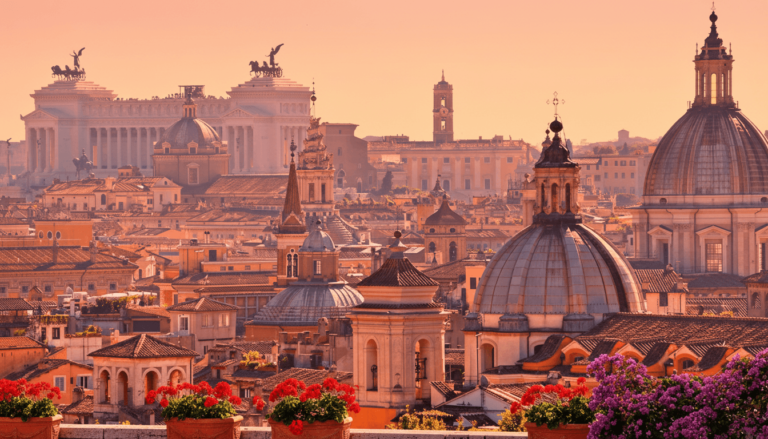


Rome is a true open-air history lesson, a stage for everyday Italian life and a city that combines its monumental past with a vibrant modern energy that is impossible not to notice.
Visiting Rome means feeling that every corner has a story waiting to be discovered. As soon as you arrive, you realize that tourism in Rome goes far beyond visiting monuments: it is an experience of living a city that moves naturally between different eras.
At every turn, Rome enchants you, whether through an architectural detail or through a local tradition that only those who walk slowly are able to notice. In this guide, you will explore the essence of the Eternal City with information, warmth and that human touch that turns a trip into a real experience.
The reasons that make Rome one of the most fascinating cities in the world
The unique atmosphere of the Eternal City
Rome has a charm that is difficult to describe, but very easy to experience. The most interesting thing is that this fascination is not found only in the main attractions.
It appears in unexpected places: in the man chatting with the barista at 8 in the morning, in the golden light falling on the facade of a 17th-century building, in the sounds that overlap — footsteps, scooters, voices, bells — creating the true soundtrack of the city.
It is an atmosphere that brings together the monumental and the familiar. Those who arrive feel it even before stepping into the first tourist landmark.
The historical experience you feel in the streets
Few cities can make you stumble upon history the way Rome does. A very simple example: you are walking toward the place where you plan to have lunch and, without any planning, you pass by a temple from the 1st century BC.
Rome does not simply “preserve” history: it lives with it. The street you walk along has already been crossed by emperors, poets, popes, medieval merchants, Renaissance architects and travelers like you.
Curiously, many contemporary buildings in the Historic Center were built on foundations that reuse blocks of Roman stone recovered over the centuries. Rome, in fact, is built on top of Rome.
How Rome affects those who visit it for the first time
The first reaction tends to be almost the same: a mixture of wonder, geographical confusion and a sudden urge to photograph everything.
But after a few hours, you adapt to the rhythm of Rome. It is slower, more reflective, more human. Then something curious happens: you realize you are smiling for no clear reason.
That is the effect of Rome. It is not visible in pictures. It is visible in the eyes.
First steps: understanding the essence of the city
The contrast between ancient and modern
Rome does not hide its contradictions, and that is exactly what makes it so fascinating. You may see a Baroque building that houses an ancient Roman tavern excavated underground.
You may watch young people enjoying an aperitivo beside a column that is two thousand years old. You may find graffiti next to Renaissance palaces. This combination is not accidental: it is part of the city’s identity.
As a historical curiosity, since 1870, when Rome became the capital of unified Italy, urban decisions were made to incorporate modernity into the city. That is why wide avenues coexist with medieval alleys, without one erasing the other.
Daily life: cafés, squares and people
If there is one place where people-watching should officially be included in the itinerary, that place is Rome. The cafés are always full, and not only because coffee is a drink. It is a ritual. A pause. A way of being with others.
In the squares, the human spectacle happens naturally. Children play, tourists look up and almost lose their balance, and Romans talk with their hands as if they were performing on stage.
There is something almost every traveler notices: despite the apparent disorder of Rome, there is a hidden order inside the chaos. Everything works… the Roman way, naturally.
The way you walk through Rome transforms the experience of the city
Rome has metro lines, buses and trams. However, there is a secret every experienced traveler quickly discovers: Rome is a city that reveals itself on foot.
The great monuments of the city are, in fact, surprisingly close to one another, which gives Rome a very human scale. It is impressive to think that, for example, between Piazza Venezia and Piazza Navona, you can cross 2,000 years of history in just a few minutes.
The more you explore, the more surprises appear: coats of arms on walls, discreet fountains, open churches with frescoes that in many other destinations would be considered major attractions.
Essential neighborhoods for your itinerary
Historic Center: the beating heart of the city
The Historic Center of Rome is home to many of its most emblematic attractions: the Pantheon, Piazza Navona, the Trevi Fountain and Campo de’ Fiori, all within a compact area, among streets that follow no geometric pattern.
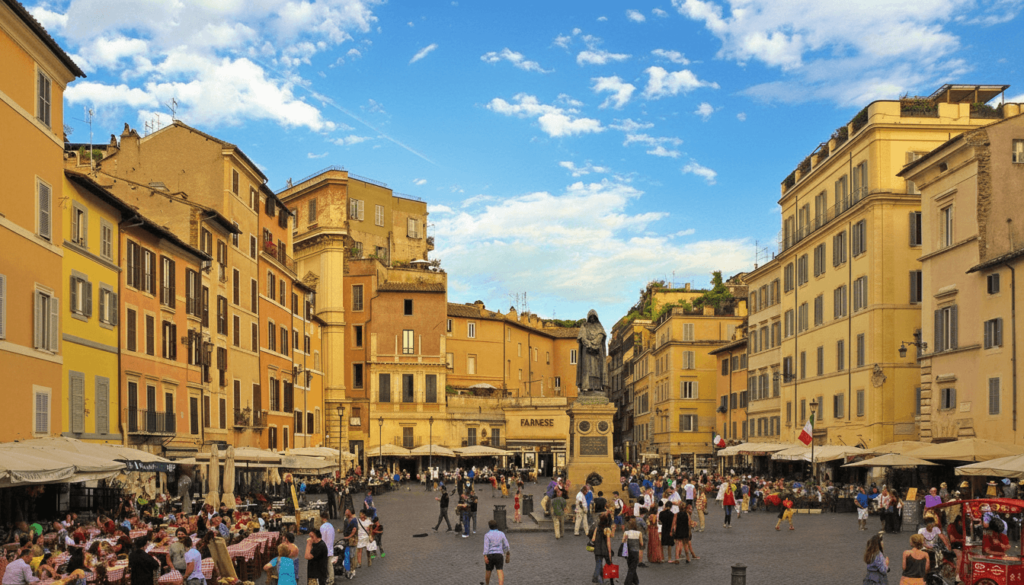
And that is wonderful, because getting lost is part of the process. It is interesting to note that the urban layout of this area is almost identical to that of the Middle Ages. So you walk along the same paths that generations of people have followed for more than a thousand years.
Trastevere: the most authentic district
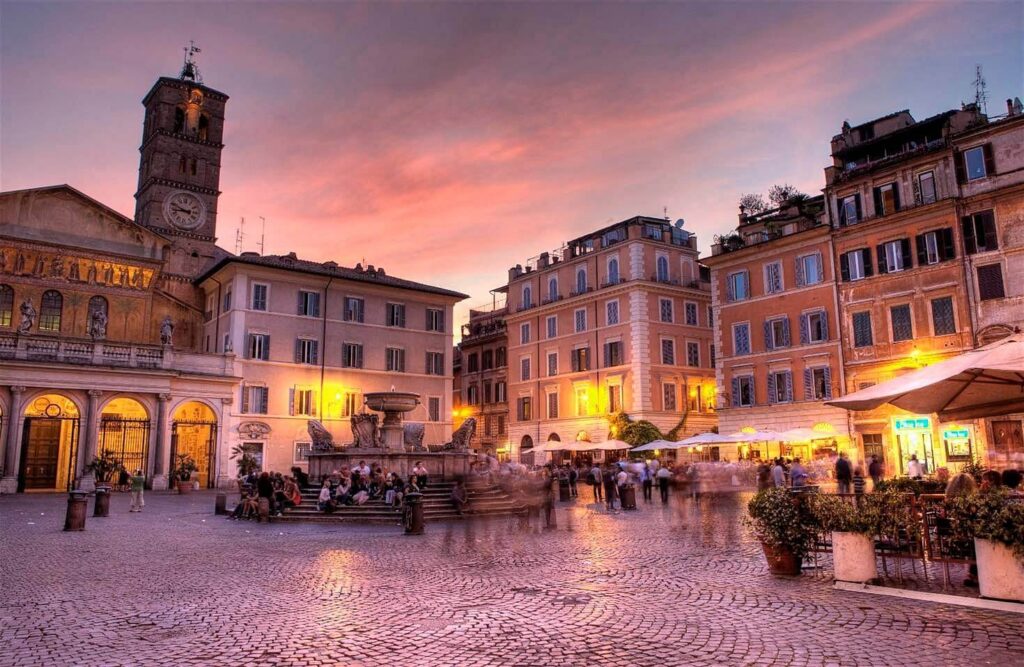
Trastevere has a soul that feels almost cinematic. Narrow streets, buildings with colorful windows, laundry hanging outside, small churches and restaurants that seem to belong to another time.
It is the neighborhood where many Romans go for dinner and where you can enjoy a more informal bohemian atmosphere. As a curiosity, the Church of Santa Maria in Trastevere is one of the first basilicas dedicated to the Virgin Mary and contains impressive mosaics from the 12th century.
Monti: the creative and young side of Rome
Monti is where contemporary Rome comes alive. Independent shops, vintage stores, minimalist cafés and alternative bars all exist in a neighborhood located between the Colosseum and Via Nazionale.
Historically, this was the area of the Suburra, a popular neighborhood of Ancient Rome inhabited by artisans and merchants. Today, it is one of the most beloved districts for those looking for a modern, creative and urban Rome.
Testaccio: the culinary Rome of the origins
Testaccio is essential for those who want to eat well, and to eat truly Roman. The neighborhood developed around Monte Testaccio, an artificial hill formed by fragments of broken amphorae from the imperial period.
This archaeological “mountain of pottery” helped shape the food culture of the area, famous for the cuisine of the quinto quarto, the less noble cuts of meat that gave rise to iconic dishes of Roman cuisine. It is an authentic, flavorful and everyday Rome.
The tourist landmarks you should not miss in Rome if it is your first time in the city
Colosseum and Roman Forum
The Colosseum, also known as the Flavian Amphitheater, was inaugurated in 80 AD. With an estimated capacity of around 50,000 spectators, it served as the setting for public games, including hunts, executions and gladiator fights.
An incredible fact: the Colosseum had a giant awning called the velarium, operated by sailors from the imperial fleet to provide shade for the spectators.
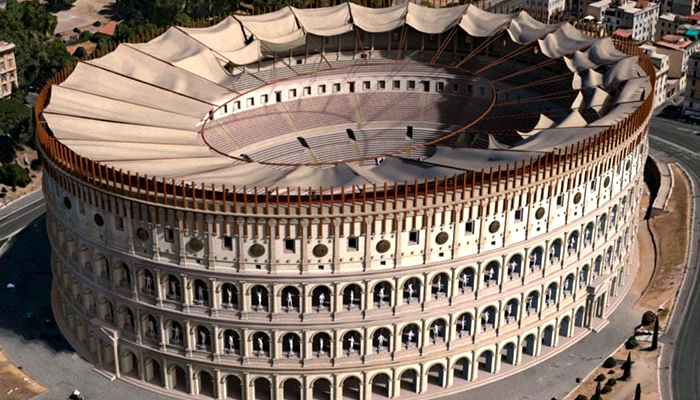
Reconstruction of the Colosseum with the Velarium.
The Roman Forum, right beside it, was the political, legal and religious center of Ancient Rome. Walking through its ruins is like crossing an open history book.
Vatican Museums, Sistine Chapel and St. Peter’s: details not everyone knows
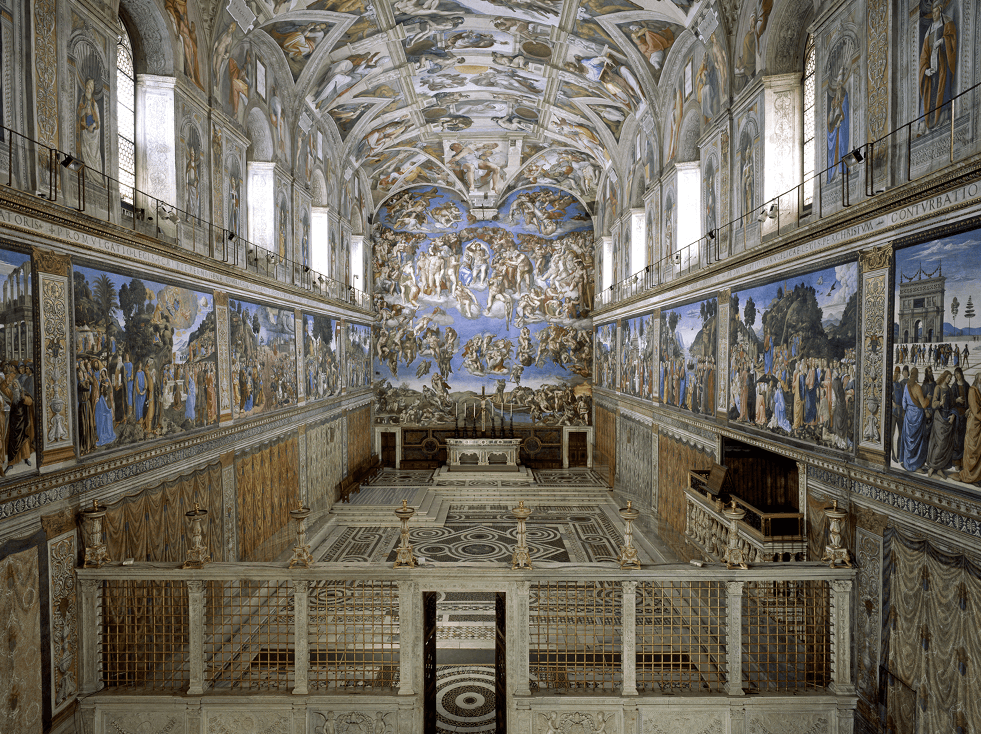
In the Vatican Museums, visitors cross centuries of art before reaching the most emblematic point of the route: the Sistine Chapel. Built at the end of the 15th century by order of Pope Sixtus IV, it already existed long before the intervention of Michelangelo Buonarroti, and it was precisely there that the artist would leave one of the most important marks in the history of art.
Long before that, while still very young, Michelangelo had created a work considered almost impossible: the Pietà (1498–1499), sculpted in Rome when he was just over 23 years old. The piece was carved from a single block of Carrara marble, extracted from the mountains of Tuscany and transported through a complex logistical process for the time: first by land, on ox-drawn carts, and then by river or sea routes until it reached the papal capital. The sculpture was finished in Rome, where the artist had the necessary space and structure. The result is a work of astonishing perfection, today protected inside St. Peter’s Basilica.
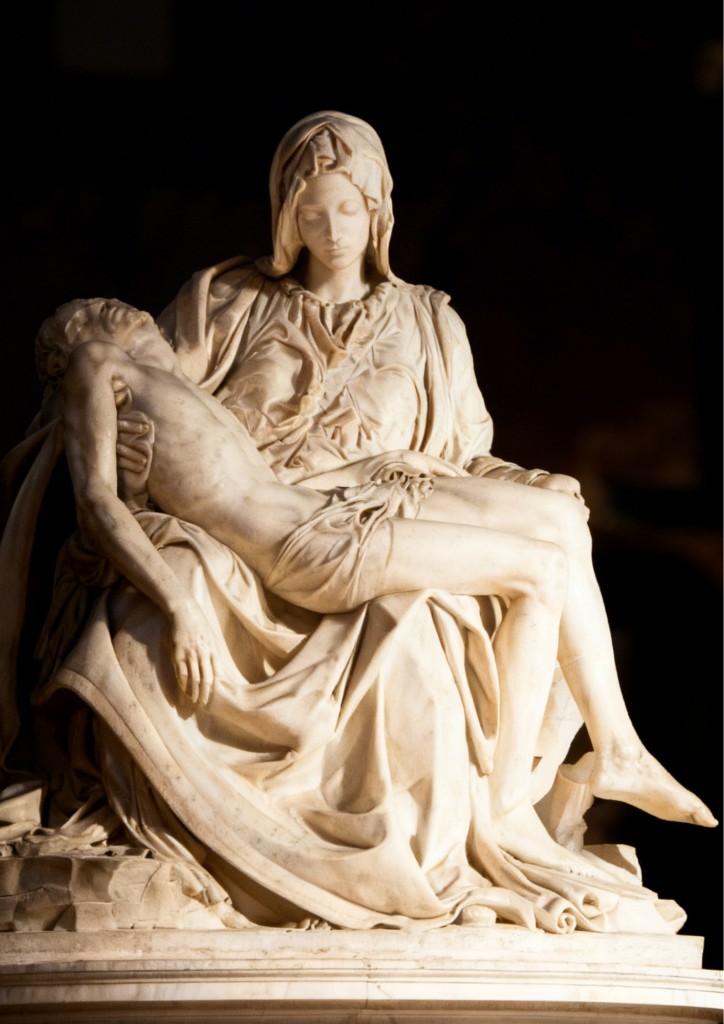
Years later, Michelangelo was commissioned to paint the ceiling of the Sistine Chapel, between 1508 and 1512. Contrary to popular imagination, he did not work lying down, but standing on scaffolding, with his neck bent upward, an extreme physical effort that he himself described in his writings. Decades later, already consecrated, he returned to the same space to create the Last Judgment on the altar wall (1536–1541), revealing a more intense and dramatic language.
Only after this monumental journey would Michelangelo take on one of the greatest challenges of his life: in 1546, already elderly, he became responsible for the design of the dome of the new St. Peter’s Basilica. The ancient Constantinian basilica was being replaced by a gigantic Renaissance project. Michelangelo redesigned the structure and defined the form that still dominates the skyline of Rome today, although he did not live to see it completed, dying in 1564.
It is important to remember that Michelangelo Buonarroti and Gian Lorenzo Bernini never met, because they belonged to different periods. Bernini emerged in the 17th century, at the height of the Baroque, decades after Michelangelo’s death. He is the one who added movement and theatricality to the complex, designing the baldachin over the altar of the basilica and the monumental colonnade of St. Peter’s Square, conceived as a symbolic embrace of the Church toward its faithful.
Thus, when visiting the Vatican, the eye follows a true timeline: from the absolute perfection of Michelangelo’s Renaissance to the grand emotion of Bernini’s Baroque, two geniuses who, although separated by time, converse harmoniously in the same setting.
Pantheon: Roman genius in stone
The Pantheon, a masterpiece of 2nd-century AD architecture, was rebuilt during the reign of Emperor Hadrian. Even today, its hemispherical dome, with a diameter of 43.3 meters, is the largest unreinforced concrete dome in the world.
Curiously, the upper oculus, measuring 9 meters, is the building’s only source of light. And here is a detail few tourists know: when it rains, water really does enter through the oculus, but the original floor had a carefully designed system of slopes and drainage channels.
Trevi Fountain: beyond the postcard
The Trevi Fountain, completed in 1762, was designed by Nicola Salvi and finished by Giuseppe Pannini. The central figure is not Neptune, but Oceanus, the primordial god of the oceans, surrounded by tritons and horses representing the power and instability of water.
The Aqua Virgo, the aqueduct that has supplied the fountain since 19 BC, still feeds it today. An interesting curiosity is that the custom of throwing a coin became popular after the release of the film “Three Coins in the Fountain” (1954). The tradition is not ancient: it is Hollywood.
Piazza Navona and its Baroque fountains
Piazza Navona stands on the site of the ancient Stadium of Domitian, dating back to the 1st century. At its center, the Fountain of the Four Rivers, by Bernini (1651), represents the great rivers of the world known at the time: the Nile, the Ganges, the Danube and the Río de la Plata.
One of the most interesting aspects is the famous rivalry between Bernini and Borromini. According to legend, the figure of the Río de la Plata covers his face as if afraid of the church facade designed by Borromini. It is false… but it is such a delightful falsehood that it is worth telling.
Piazza di Spagna and its famous steps
The asymmetrical staircase leading to the Church of Trinità dei Monti was designed by Francesco de Sanctis and completed in 1725. It is truly beautiful, but since 2019 it has been strictly forbidden to sit on the steps, with fines that can reach 400 euros.
Right there you will also find the iconic Babington’s Tea Room, founded in 1893, a true British refuge in the heart of Rome.
Circus Maximus: a colossus in silence
Today it is a vast green space, but the Circus Maximus was the largest stadium of Ancient Rome, capable of holding more than 150,000 people. It is astonishing to imagine that chariot races lasting for hours once took place there.
Roman cuisine: a journey within the journey
Rome is a city that is also understood through gastronomy. Roman cuisine is the result of centuries of tradition, popular influences, modest creativity and a strong identity that does not easily follow trends.
When we say that eating in Rome is not merely “having a meal,” but entering into contact with the very soul of the city — and believe me, that soul has flavor — we are talking about an experience that goes far beyond the simple act of eating.
The essential dishes of Roman cuisine
The cuisine of the region is simple, sincere and uncomplicated, just like the Romans. Each traditional dish was born from the combination of necessity, imagination and humble ingredients, but with intense flavor.
Spaghetti alla carbonara
Authentic Carbonara is almost like a scientific creation. Do not even think about using cream: in Rome, that would be a true sacrilege. The real creaminess comes from the perfect emulsion between egg yolks, pecorino romano and the fat of guanciale, cured pork cheek that, when prepared correctly, releases a powerful aroma and a crisp texture.
An appetizing curiosity: the carbonara we know today does not appear in Italian cookbooks before the 1940s. Some research suggests it may have emerged in the postwar period, when American soldiers left their rations of bacon and eggs in the city. Whether legend or reality, one thing is undeniable: today it represents Rome completely.
Amatriciana
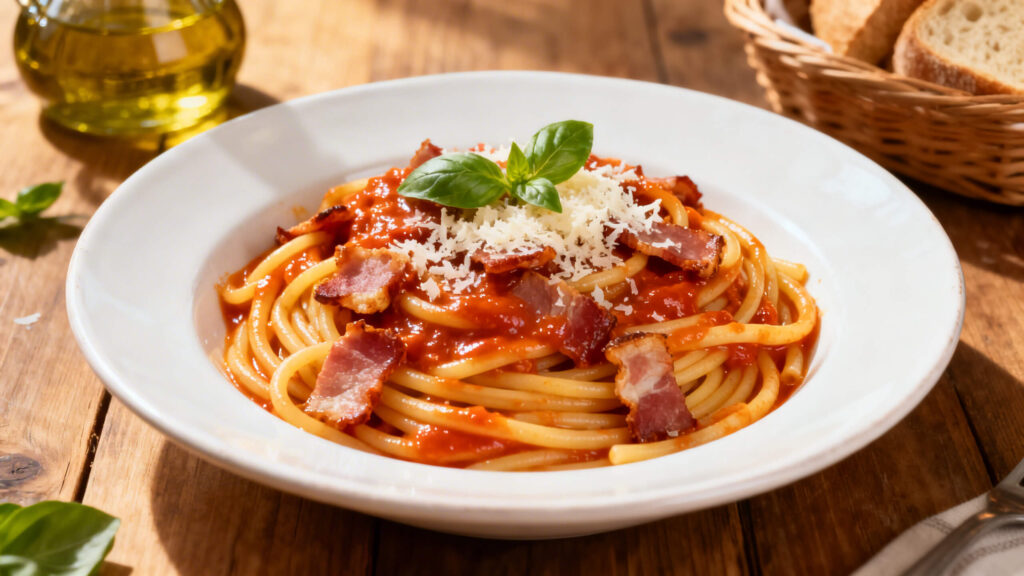
Originally from Amatrice, but adopted by Rome, Amatriciana is a strong expression of culinary identity. Made with tomato sauce, pecorino and guanciale, it is so classic that the recipe is officially recognized by the association of producers from Amatrice.
Cacio e pepe
Few dishes represent Roman minimalism as well as Cacio e Pepe: only pasta, pecorino and black pepper. But do not be fooled: it is a difficult dish to prepare well. Achieving the right creaminess requires technique and care in the emulsion.
Cultural note: this was the food of shepherds from Lazio, who carried only aged cheese and pepper. It was a kind of medieval “fast food.”
Carciofi alla giudia and alla romana
The relationship between Rome and artichokes is almost emotional.
- Alla giudia: fried whole until very crispy, of Jewish-Roman origin.
- Alla romana: slowly cooked with garlic, wild mint and olive oil.
It is a dish that also speaks of the history of the Jewish community of Rome, one of the oldest in Europe.
Puntarelle
A classic Roman winter salad made with crunchy chicory and an anchovy-based dressing. It is delicate, pleasantly bitter and very fresh, the ideal balance for the city’s richer dishes.
The gastronomic essence of Testaccio and the “quinto quarto”
Testaccio is the part of Rome where people truly eat. The neighborhood developed around Monte Testaccio, a hill formed by millions of broken amphorae, remnants of olive oil imports during the imperial period.
It was in this neighborhood that the concept of the quinto quarto was born, connected to the less valued cuts of meat, such as tongue, oxtail and tripe. Prepared with creativity, they became traditional dishes, including:
- Coda alla vaccinara
- Trippa alla romana
- Coratella with artichokes
This side of Rome is authentic: a cuisine created by Romans and for Romans.
Where to eat: truly traditional addresses
Now we arrive at the section that truly matters to any traveler who loves good food: where to find good restaurants while avoiding tourist traps.
Da Enzo 29 (Trastevere)
Small, sought-after and loved by Romans themselves. One of the city’s most famous carbonaras truly deserves its reputation. Arrive early or make a reservation. It is almost always a safe choice.
Da Teo (Trastevere)
Famous for its fish dishes and homemade pasta. It is one of those places where the waiter tells you what came fresh from the market that day. Genuine, warm and always full.
Da Costanza (Theater of Pompey)
One of the most atmospheric restaurants in Rome is located under the arches of the ancient Theater of Pompey, yes, the same complex connected to the end of Julius Caesar. Here, the connection between history and gastronomy is very real.
Sweets, pauses and Roman pleasures
Rome is the perfect place to enjoy a good meal, but also to take delicious breaks between one attraction and another.
Pompi: the most famous tiramisù in the city
Classic, creamy and available in several variations, such as strawberry and pistachio. It is a modern Roman symbol, loved by tourists and locals alike.
Babington’s Tea Room (Piazza di Spagna)
Founded in 1893 by two English women, it is a little piece of England in the Italian capital. A place that combines elegance, calm and history.
Perfect for resting your feet, but not on the steps: remember the fine. Curiously, Babington’s managed to remain open through two world wars.
Practical and smart tips for exploring Rome
Rome requires more heart than strategy. Still, a few tactics can save time and prevent frustration.
How to avoid lines and crowds
- Colosseum, Forum and Palatine Hill: book through the official website and avoid ticket touts.
- Vatican Museums: go very early or after 4 pm.
- Borghese Gallery: entry is only with advance reservation and a scheduled time slot.
- The Roma Pass can be useful, but it is not essential.
Useful curiosity: the Colosseum offers “quiet hours” on certain days, with a reduced number of visitors.
How to get around without stress
Rome is a city that can be explored on foot, but when you need to use public transport:
- The metro has only 3 lines, but it serves the main areas.
- Buses work reasonably well, although delays can happen.
- Authorized taxis are safe: avoid those that approach you insistently.
- Continuing to walk is often the best strategy.
Urban curiosity: some bus drivers in Rome make the sign of the cross before starting the route. It is not a legend, but an old habit.
How to avoid tourist traps
Avoid:
- Restaurants with enormous menus in 10 languages
- People insisting at the door to bring you in
- Unclear prices
- Food courts disguised as “trattorie”
Prefer:
- Side streets
- Places full of Italians
- Shorter menus
- Visible kitchens or places with an authentic atmosphere
Rome has its share of tourist traps, but it also has plenty of authenticity: often, walking just 200 meters farther is enough.
How to enjoy Rome calmly
Rome teaches a simple truth: if you try to see everything, you may end up truly seeing nothing. The city rewards those who take their time.
Sitting in Piazza Navona and watching the movement of people, not on the fountains, of course, can already justify the trip. There is one essential rule: let Rome lead you where you need to go. Even when it was not in the plan.
The Rome you carry with you
The emotional effect of the city
Rome affects the traveler in a way few other cities can. It may be the light, the narrative, the sound of conversations. Rome creates an emotional memory, the kind that remains in the body, not only in the photo album.
Why Rome always feels unfinished on a first visit
Because Rome is inexhaustible. With every new visit, a different neighborhood seems to call for your attention. A church you had never seen invites you in. A ruin that once did not interest you suddenly becomes irresistible.
Rome is not just a place: it is a journey. There are cities you get to know. And there are cities that mark you. The city of Rome belongs to the second category.
The city that refuses to be visited in just one trip
Rome does not fit into an itinerary. It is too vast, human, ancient and vibrant to be contained in a single visit.
Perhaps that is its greatest virtue: you return home with the feeling that everything is still there, waiting for your return. And you return.
Frequently asked questions about Rome
How many days are ideal for visiting Rome for the first time?
For a first trip, the ideal is to spend at least 4 days in Rome. This allows you to visit the essential places, such as the Colosseum, Roman Forum, Vatican, Pantheon, Trevi Fountain and Piazza Navona, without turning the trip into a race. With more time, it is worth including neighborhoods such as Trastevere, Monti and Testaccio.
Is Rome a good city to explore on foot?
Yes. Rome is one of the best cities in Italy to discover on foot, especially in the Historic Center. Many monuments are relatively close to one another, and part of the city’s charm lies precisely in the discoveries made along the way: open churches, discreet fountains, ancient streets, cafés and lively squares.
Which neighborhoods are worth visiting in Rome beyond the classic tourist attractions?
In addition to the Historic Center, it is worth visiting Trastevere, Monti and Testaccio. Trastevere has a bohemian and deeply Roman atmosphere, Monti shows a younger and more creative Rome, while Testaccio is an excellent choice for those who want to discover the most authentic Roman cuisine.
What should you eat in Rome to taste true Roman cuisine?
Among the most traditional dishes are carbonara, amatriciana, cacio e pepe, carciofi alla giudia or alla romana, as well as recipes connected to the quinto quarto, especially in Testaccio. Roman cuisine is simple, intense and deeply linked to the city’s popular history.
How can you avoid tourist traps in Rome?
The best strategy is to avoid restaurants with enormous menus in many languages, unclear prices and people insisting at the entrance. Choose side streets, places frequented by Italians, shorter menus and restaurants where the food seems to be part of the neighborhood’s daily life, not only the tourist circuit.

 ✍️ Idealizadora e autora do Verament...