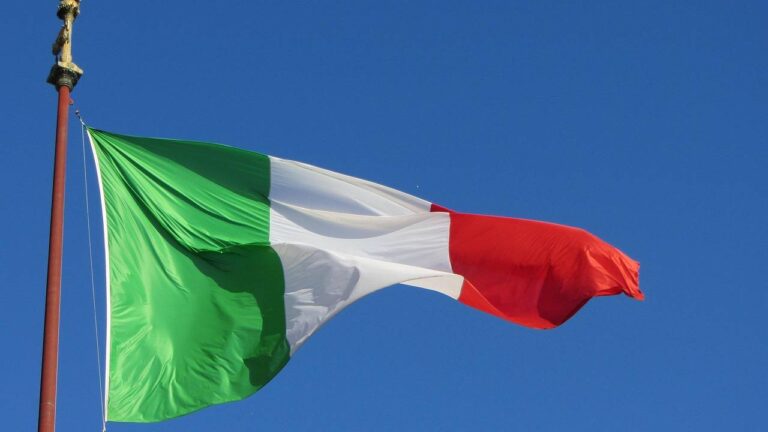


The Italian flag and the blue color associated with the House of Savoy are deeply rooted symbols in Italy’s identity and history. This article explores in detail the origin and meaning of the Italian tricolor and the shade of blue which, although not present in the national flag, plays a significant role in Italian culture and sports.
The History of the Italian Flag
Known as “Il Tricolore,” the flag of Italy consists of three vertical stripes of equal width in green, white, and red, arranged from left to right. The official proportion of the flag is 2:3. The origin of this national symbol dates back to the late 18th century, during a period of intense political transformations in Europe.
Napoleonic Origin
In 1796, during the Napoleonic campaigns, the northern part of the Italian Peninsula was occupied by French troops led by Napoleon Bonaparte. In this context, the Cispadane Republic, a sister republic of revolutionary France, was established and adopted a tricolor flag on January 7, 1797. The chosen colors were red and white, derived from the flag of Milan, and green, which was the color of the Milanese civic guard uniforms. This combination symbolized the unity and identity of the newly formed territories.
Evolution and Meaning of the Colors
Over the years, the tricolor flag underwent several modifications, reflecting the political and social changes in the region. During the Napoleonic period, the tricolor was associated with the ideals of liberty, equality, and fraternity, influenced by the French Revolution. With the Italian unification in the 19th century, the flag became a symbol of the struggle for independence and national unity.
Although there are various interpretations of the colors’ meanings, one of the most accepted is that green represents the Italian plains and hills, white symbolizes the snow-covered Alps, and red recalls the blood shed by patriots in the fight for independence. Another interpretation suggests that the colors represent virtues: green for hope, white for faith, and red for charity.
In gastronomy, the tricolor is also present in the most beloved and simple flavors of tomatoes, mozzarella, and basil, which add fragrance and joy to many Italian recipes, and above all, our most traditional and beloved pizza.

The Savoy Blue and the Italian Royal House
Although the Italian national flag does not include the color blue, this shade has a deep historical and cultural significance in Italy, especially due to its association with the House of Savoy.
Origin of Savoy Blue

The House of Savoy, one of the oldest noble dynasties in Europe, played a crucial role in Italian unification. The blue color, known as “azzurro Savoia,” became associated with the royal family in the mid-14th century. In 1366, during an expedition to the Crusades, Amadeus VI of Savoy, also known as the Green Count, decided to hoist a blue banner on his ship alongside the family’s traditional coat of arms, which featured a white cross on a red background. This gesture symbolized devotion and divine protection, possibly in reference to the blue mantle of the Virgin Mary, reinforcing the connection between the color blue and spirituality.
Savoy Blue in Italian Sports
With the unification of Italy in 1861 under the leadership of the House of Savoy, “azzurro Savoia” was adopted as the official color of Italian national sports teams. This tradition continues to this day, with Italian sports teams affectionately called “Azzurri,” referring to the distinctive blue color of their uniforms. This choice symbolizes historical continuity and pays tribute to the dynasty that played a central role in forming the Italian nation.

The Influence of Blue in Italian Culture
Beyond sports, the color blue has a strong presence in Italian culture and art. Historically, blue was considered a noble and highly valued color. During the medieval period, the Virgin Mary was often depicted wearing a blue mantle, a choice that not only reflected its religious symbolism but also the high cost and prestige associated with blue pigment in Renaissance art. Renowned painters such as Raphael used this color to highlight the divinity and importance of the figures portrayed.
The Italian tricolor flag and “azzurro Savoia” are more than mere visual symbols; they encapsulate the rich tapestry of Italian history, culture, and identity. While the tricolor represents the nation’s journey toward unity and independence, the blue color pays homage to monarchical roots and the deep spirituality that shaped the country. Together, these symbols continue to inspire pride and cohesion among Italians, reflecting a heritage celebrated both in sports arenas and in Italy’s cultural and artistic expressions.
Links
House of Savoy
The Color Blue in Art History

 ✍️ Idealizadora e autora do Verament...