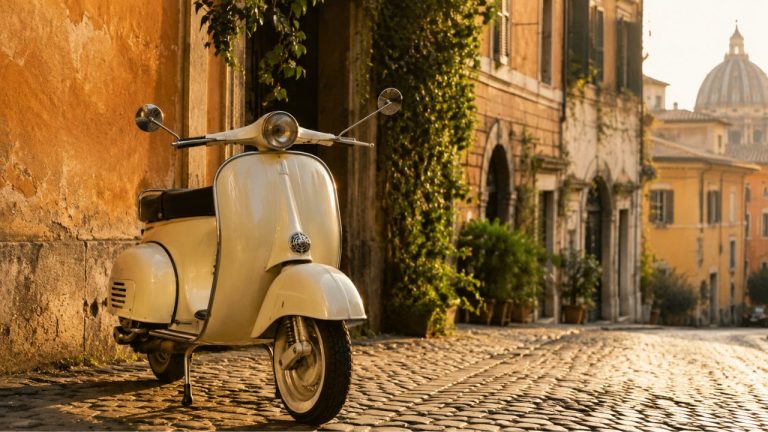


Vespa Piaggio is not just the name of an Italian scooter. It is an image that crosses collective memory: a stone street in Rome, a luminous curve in Tuscany, a helmet hanging from an arm, the light sound of an engine passing in front of an old façade.
Since April 23, 1946, when the Vespa was officially born, this small vehicle created by Piaggio in Pontedera stopped being merely a mobility solution and became one of the most recognizable symbols of Italy in the world.
In 2026, as it turns 80, the Vespa continues to carry something that few objects are able to preserve for so long: the idea of freedom with elegance, movement with beauty, everyday life with an irresistible touch of Dolce Vita.
Vespa Piaggio: when a scooter stops being just a scooter
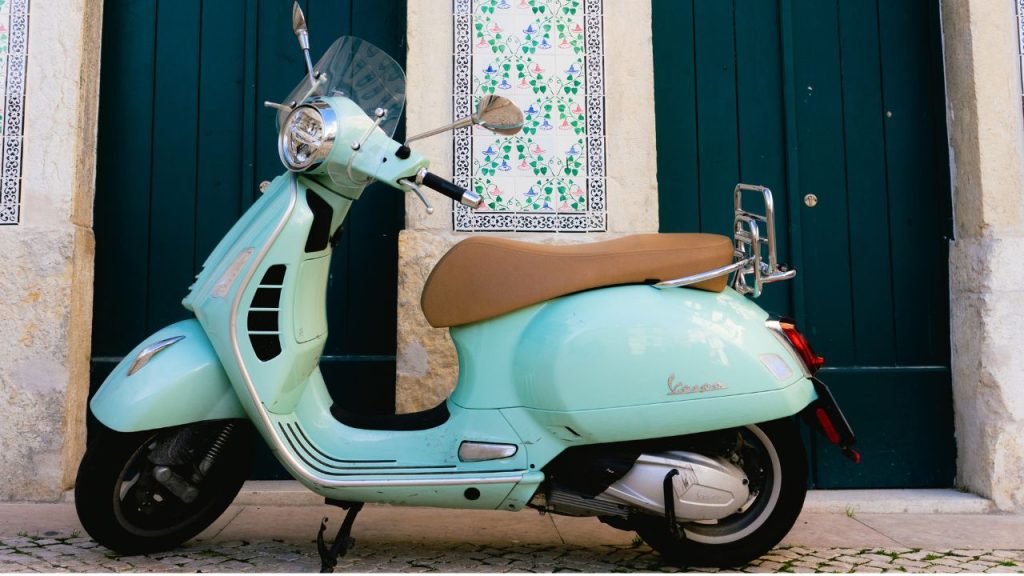
Some objects seem to be born to fulfill a function. Others, through a rare combination of form, historical moment and collective emotion, go beyond their function and become a language.
The Vespa Piaggio belongs to this second category. It carries people, yes. But it also carries memories, fantasies, cinematic images, ideas of youth, dreamed journeys and a certain Italian way of inhabiting the world.
When someone sees a Vespa parked in front of a café, leaning against a peeling wall in Rome or crossing the square of a small town, they do not see only a means of transport. They see a promise: that life can be lighter, freer, more beautiful and less rigid.
This is why the Vespa became such a powerful Italian symbol. On two wheels, it summarizes an essential part of Italian culture: the ability to unite utility and beauty, engineering and charm, everyday life and imagination.
April 23, 1946: the official birth of the Vespa
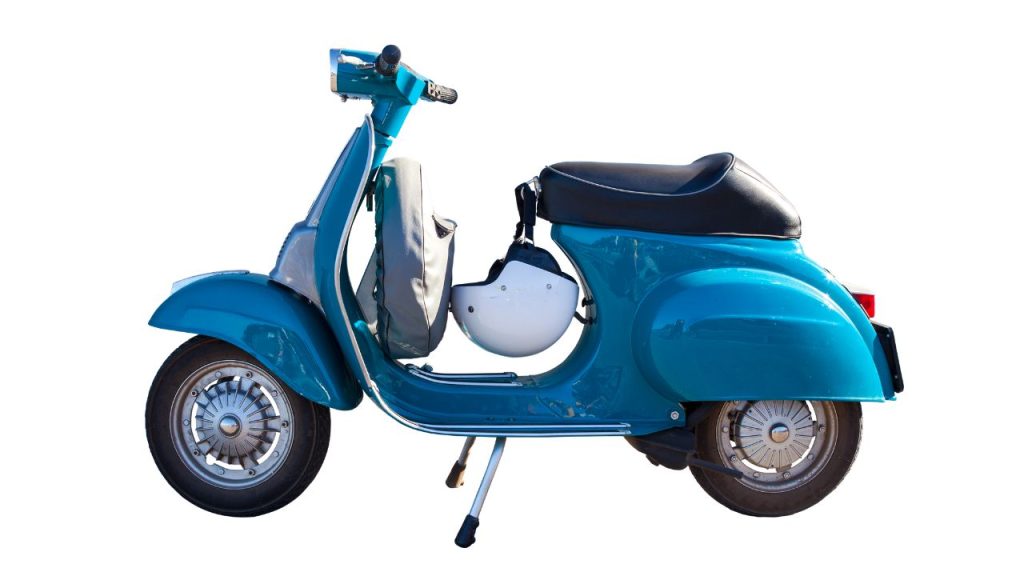
The Vespa was officially born on April 23, 1946, at a time when Italy was still carrying the deep wounds of the Second World War. The country needed to rebuild factories, cities, roads, family economies and, above all, trust in the future.
The official page Vespa 80 Years of an Icon remembers this origin as the birth of a dream on two wheels, created in Pontedera to set post-war Italy in motion again.
It was not merely a matter of producing a vehicle. It was necessary to restore movement to a population that needed to work, travel, rediscover opportunities and rebuild its urban life.
Piaggio, a company historically connected to the aeronautical and railway industries, found in Pontedera, Tuscany, the setting for this transformation. The factory had been severely affected by the war, and the post-war period demanded a different kind of industrial intelligence: less oriented toward conflict, more connected to civilian life.
It was in this context that Enrico Piaggio searched for a new answer. The idea was to create a simple, accessible, low-cost vehicle, easy to use and suitable for a country that needed to move again.
Piaggio, Pontedera and Tuscan industrial intelligence
To understand the Vespa, one must look at Pontedera. The town, located in Tuscany between Pisa and Florence, does not have the immediate fame of other Italian tourist destinations. Yet it holds a fundamental place in the industrial and cultural history of the country.
It was there that the Vespa gained body, sound and identity. Pontedera is not only the address of a factory: it is the place where a company had to reinvent its productive vocation and transform technical knowledge into everyday mobility.
The bond between Piaggio, Pontedera and Vespa is so strong that the town has become a kind of emotional territory for vespisti from all over the world. Those who love the Vespa do not see Pontedera merely as a point on the map, but as an origin.
This memory is preserved at the Museo Piaggio in Pontedera, a space dedicated to the history of Piaggio, the Vespa and Italian mobility. For those traveling through Tuscany with a cultural eye, the museum reveals a less obvious Italy, made of design, industry, workers’ memory and innovation.
A democratic idea with Italian elegance
The Vespa was born from a practical need, but it was never a banal solution. This is perhaps one of the great secrets of Italian design: solving concrete problems without giving up form, proportion, beauty and emotion.
In the post-war years, Italy needed an accessible vehicle. But the Vespa offered something more. Its structure protected the rider better from road dirt, its riding position was more comfortable than that of a traditional motorcycle, and its design seemed almost gentle.
There was no aggressiveness in its presence. The Vespa was modern, but not cold. Popular, but not vulgar. Simple, but not poor. It offered mobility with natural elegance, as if saying that even the daily commute could have style.
This combination helped turn the Vespa Piaggio into a phenomenon. It served to go to work, meet friends, visit a loved one, cross the city, reach the sea, go out without a precise destination. It was practical, but also emotional.
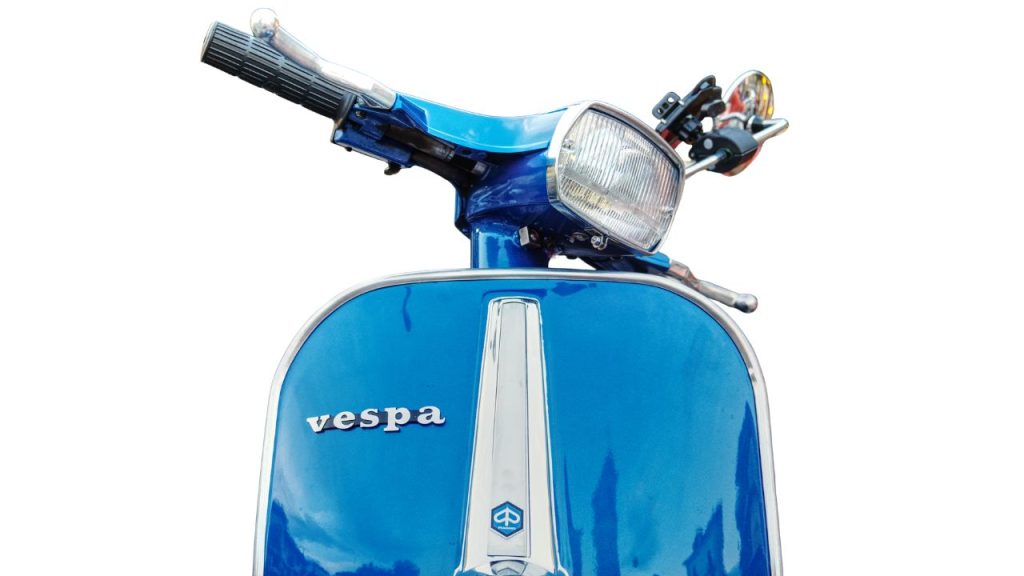
The design that became a signature
There are objects we recognize before even reading their name. The Vespa is one of them. Its rounded silhouette, enveloping bodywork, elegant front and compact proportions created an immediate visual signature.
This is an essential point: the Vespa did not become an icon only because it sold in large numbers. It became an icon because it has a memorable shape. A shape capable of crossing decades without losing its identity.
The Vespa may change model, color, technology and generation. But it remains recognizable. This visual continuity is one of the reasons why it is regarded as an object of Italian design, not merely as a vehicle.
Italian design has always had this ability to give objects a soul. A coffee maker, a chair, a small car, a lamp or a scooter can express a vision of the world. In the case of the Vespa, that vision is clear: to move with freedom, without losing grace.
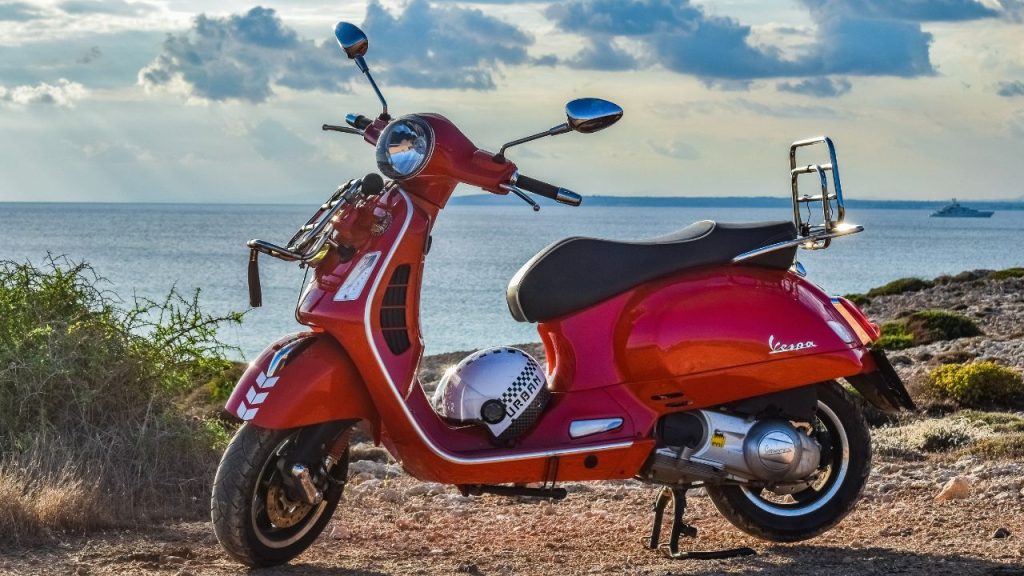
Freedom, youth and reconstruction: the symbolic soul of the Vespa
Few objects tell so well the passage from a wounded Italy to an Italy once again eager to live. The Vespa was born in a country that needed to rebuild its cities, but also its relationship with the future.
For this reason, from the beginning, it was associated with freedom. Not the abstract freedom of grand speeches, but the concrete freedom of leaving home, crossing a city, visiting someone, going a little farther with autonomy.
For many young Italians, the Vespa represented a first taste of independence. For many families, it represented a new possibility of movement. For the country, it became an image of reconstruction, optimism and motion.
The youthfulness of the Vespa does not lie only in the age of those who rode it. It lies in the energy it projected: a lighter Italy, less trapped in trauma, more ready to rediscover the pleasure of streets, encounters, Sundays, holidays, squares and summer.
Vespa, cinema and Dolce Vita: when Rome became the world’s stage
The international consecration of the Vespa did not happen only in the streets. It also happened on the big screen. Cinema helped transform the Italian scooter into a desired, exportable image immediately associated with Italy.
One of the most famous moments in this relationship is the classic Roman Holiday, released in 1953, starring Audrey Hepburn and Gregory Peck. The image of the protagonists riding through Rome on a Vespa entered the world’s imagination and connected the scooter to a romantic, luminous and youthful idea of the Italian capital.
The page of the Museo Piaggio itself helps preserve this relationship between Vespa, cinema and popular culture, showing how the Italian scooter crossed not only roads, but also screens, photographs and imaginations.
It is important not to confuse things: the Vespa already existed before becoming a cinematic image. Cinema did not invent the Vespa. But it helped the world dream of it.
From that moment on, the scooter became part of an international iconography of Italy: Rome, ancient streets, sunglasses, light dresses, squares, sun, youth, holidays, freedom and that seemingly effortless elegance the world learned to call Dolce Vita.
The Vespa and the international imagination of Italy
For many foreigners, the Vespa is one of the first mental images associated with Italy. Even before knowing Pontedera, before studying the history of Piaggio, before understanding the post-war context, many people already recognize the Vespa as an Italian symbol.
It appears in travel photographs, magazine covers, contemporary postcards, shop windows, films, fashion campaigns, urban scenes and emotional memories. Sometimes, a Vespa parked in front of a yellow wall is enough to create an entire atmosphere.
This emotional power is rare. The Vespa does not speak only to those who ride it. It also speaks to those who observe it. For an Italian, it may recall youth, family, the city, summer, the road, first love. For a foreigner, it may represent the Italy of dreams: elegant, sunny, free and deeply human.
That is why the Vespa Piaggio has not aged like so many industrial products. It has become a shared memory. And shared memories do not depend only on technology: they depend on affection.
Vespa Roma 2026: 80 Years of an Icon
In 2026, the Vespa turns 80. And the celebration of this anniversary found a stage worthy of its imagination: Rome.
From June 25 to 28, 2026, the Italian capital hosted the Vespa Roma 2026 celebration, officially presented as 80 Years of an Icon. For four days, Rome became a meeting point for Vespa lovers, vespisti, collectors, curious visitors and admirers of this Italian symbol.
The choice of Rome could not have been more meaningful. If Pontedera is the industrial and emotional origin of the Vespa, Rome is one of its great symbolic stages. It was precisely in the streets of Rome that the Vespa conquered some of its most famous images, especially in cinema and in the international tourist imagination.
According to the official news from the Piaggio Group on the opening of the Vespa celebrations in Rome, the inauguration of the Vespa Village at the Foro Italico marked the official start of the event, with thousands of vespisti arriving in the capital and a photographic exhibition dedicated to the icon’s 80 years.
The official page Vespa Celebrates 80 Years in Rome presents the celebration as the largest event in the history of the brand, bringing together vespisti from different parts of the world in the Eternal City.
The birthday of a brand and of a collective memory
Celebrating 80 years of the Vespa does not mean celebrating only a brand. It means celebrating an Italian and international collective memory.
The Vespa crossed generations because it did not remain trapped in a single decade. It belonged to the post-war period, to the years of the economic boom, to urban youth, to cinema, to fashion, to tourism, to collectors, to travelers and now also to a new generation that rediscovers icons with history.
There is something deeply Italian in this permanence. Italy knows how to transform objects into emotional heritage: a coffee at the counter, a square at sunset, a family recipe, a song, a piece of design, a small scooter that seems to carry an entire country on two wheels.
The Vespa remains current because it does not depend only on nostalgia. It renews itself, but remains faithful to its identity. And this is one of the great lessons of true icons: to change without losing oneself.
Museo Piaggio in Pontedera: where history takes shape
For those traveling through Tuscany and wishing to go beyond the most predictable itineraries, Pontedera can become a precious stop. The town allows visitors to understand an Italy that is less touristic and more industrial, creative and concrete.
The Museo Piaggio preserves this dimension. Its collections do not tell only the story of a scooter, but that of a company, a territory and a country in transformation.
There, the Vespa stops being only an image and becomes matter: models, documents, prototypes, archives, lines of evolution, objects that help us understand how an industrial idea can cross decades and become culture.
For the traveler passionate about Italian design, the museum offers an experience different from the classic Tuscany of vineyards and medieval towns. It is a Tuscany of factories, engineering, workers’ memory, innovation and national identity.
This contrast is beautiful. Because Italy is not made only of Roman ruins, Renaissance churches and perfect landscapes. Italy is also made of workshops, roads, engines, hands that design, lines that draw and objects that transform everyday life.
The Vespa as an object of Italian design
When we speak of Italian design, we often think of furniture, fashion, sports cars, lamps or architecture. But the Vespa occupies a special place because it belongs to everyday life.
It was not conceived to remain untouched in an exhibition room. It was made to circulate. To face roads, rain, sun, commutes and small urban adventures. And yet, it became worthy of a museum.
This is the greatness of true design: it does not separate beauty and use. The Vespa is beautiful because it works, and it works without ceasing to be beautiful. Its form is not an empty ornament; it is part of its intelligence.
Over time, the Vespa also entered the universe of lifestyle. Helmets, jackets, photographs, club gatherings, international events, travel memories and collecting created a culture of its own around the scooter.
But, at the center of everything, the same idea remains: an Italian way of living movement.
The emotional power of the Vespa for Italians and foreigners
A symbol becomes powerful when different people are able to place their own emotions inside it. The Vespa does exactly that.
For an Italian, it may be the memory of adolescence, of a father, of an uncle, of a summer, of a small town, of a first ride, of a time when everything seemed to be beginning. For a foreigner, it may be the image of an Italy desired, perhaps not yet lived, but already felt.
The curious thing is that the Vespa manages to be intimate and international at the same time. It belongs to Pontedera, it belongs to Piaggio, it belongs to Italian history. But it also belongs to the gaze of those who learned to love Italy from afar.
For this reason, it is so useful for thinking about Italian culture. The Vespa shows how an object can bring together history, design, cinema, economy, language, affection and tourism in a single image.
It is a small lesson in Italy on two wheels.
The Vespa as a lesson in living Italian
At Veramente Italiana, culture never appears separated from language. A theme such as the Vespa Piaggio can become a rich lesson in living Italian, especially for students interested in travel, conversation, national symbols and cultural vocabulary.
The Vespa allows us to work with simple but highly expressive words: la Vespa, lo scooter, il casco, la strada, la piazza, la libertà, il viaggio, guidare, fare un giro, salire in Vespa, il design italiano, la Dolce Vita.
It also allows us to introduce natural conversation expressions such as: Facciamo un giro in Vespa?, Mi piacerebbe visitare Pontedera, La Vespa è un simbolo della cultura italiana, Hai mai visto una Vespa d’epoca? and Per me la Vespa rappresenta libertà.
In a conversation class, the theme can open questions that are far more interesting than simple grammar exercises. The student can answer: what does the Vespa represent to you? Can an object symbolize an entire country? What image comes to your mind when you think of Italy? Would you visit the Museo Piaggio in Pontedera? Which film scene do you associate with Rome?
From these questions, language stops being a list of rules and becomes experience. The student learns vocabulary, but also learns to think in Italian, to build an opinion, to speak about memory, desire, travel and culture.
Cultural themes to explore in class
The Vespa can be the starting point for many cultural themes. The first is post-war Italy and the reconstruction of the country, with the need for accessible and democratic mobility.
Another theme is Italian design, especially the idea that beauty and function can walk together. The Vespa helps the student understand that Made in Italy is not only luxury, but also intelligence applied to everyday life.
It is also possible to work on Rome in cinema, the imagery of Dolce Vita, the difference between real tourism and dreamed tourism, the relationship between objects and national identity, as well as vocabulary related to the city, movement and travel.
For students who wish to travel to Italy, the theme also makes it possible to create cultural itineraries: Rome through the images of the Vespa, Tuscany beyond the clichés, Pontedera and the Museo Piaggio as a stop for those who love design, history and Italian culture.
It is an article that can become guided reading, debate, a thematic lesson, a vocabulary exercise, a writing activity and even oral practice for intermediate-level students.
More than nostalgia: why the Vespa is still current
It would be easy to speak of the Vespa only with nostalgia. But that would be reductive. The Vespa has not survived for 80 years only because it recalls the past. It continues to live because it still communicates something desirable in the present.
In an accelerated, heavy and often impersonal world, the Vespa preserves an idea of human mobility. It suggests closeness to the street, to the body, to the landscape, to the route.
It is not only speed. It is presence. It is not only displacement. It is style. It is not only a machine. It is a gesture.
Perhaps this is why it continues to move people. The Vespa reminds us that the way we move also says something about the way we wish to live.
When Italy passes by us on two wheels
The Vespa Piaggio turns 80 in 2026 as one of the strongest icons of Italian culture. It was born in Pontedera, on April 23, 1946, connected to the reconstruction of a country that needed to move again. It conquered the world through streets, cinema, design and emotion.
But the Vespa is not great only because of its history. It is great because it remains small enough to fit inside a memory: a street in Rome, a Tuscan square, a summer ride, an old photograph, an Italian lesson, a journey still dreamed of.
Eight decades later, it continues to tell the world something profoundly Italian: freedom can have a shape, beauty can be everyday, and life, sometimes, becomes more beautiful when it passes by us on two wheels.
Frequently asked questions about the Vespa Piaggio
When was the Vespa Piaggio officially born?
The Vespa was officially born on April 23, 1946. The date is celebrated by the brand as the beginning of a story that transformed the Italian scooter into a global symbol of freedom, style and design.
Why is the Vespa considered an Italian symbol?
Because the Vespa brings together accessible mobility, elegant design, youth, cinema, Dolce Vita and emotional memory. It represents a creative, popular, sophisticated Italy deeply connected to the pleasure of living.
What is the connection between Vespa, Piaggio and Pontedera?
The Vespa was created by Piaggio and its history is linked to Pontedera, in Tuscany, the town where Vespa production was consolidated and where today the Museo Piaggio is located, a space dedicated to the memory of the company and its iconic vehicles.
What was Vespa Roma 2026?
Vespa Roma 2026 – 80 Years of an Icon was the official celebration of the Vespa’s 80th anniversary, held in Rome from June 25 to 28, 2026, with events, vespisti gatherings, exhibitions and tributes to the Italian icon.
How can the Vespa be used in Italian lessons?
The Vespa can be used to work on vocabulary related to mobility, travel, the city, design, cinema and Italian culture. It also offers excellent conversation prompts about national symbols, Dolce Vita, Rome, Pontedera and cultural identity.
Official sources used
For this article, official sources from Vespa, Piaggio Group, Museo Piaggio and Paramount Pictures were consulted.
Vespa Celebrates 80 Years in Rome
Piaggio Group on the opening of the Vespa celebrations in Rome
Official history of the Piaggio Group
Museo Piaggio — official website in Italian

 ✍️ Idealizadora e autora do Verament...