The color blue, with its celestial depth and aura of mystery, runs through the history of Italian art as a guiding thread between the divine and the earthly. From Giotto‘s frescoes to Raphael‘s harmonious compositions, passing through the masters of the Renaissance and Baroque, blue has always been imbued with symbolism and meaning. But how did it become so essential to the aesthetics and spirituality of Italian art? Let’s embark on a chromatic journey that reveals its path and importance.
Giotto and the Revolution of Celestial Blue
At the end of the 13th century, Italian art was undergoing a decisive transformation. Giotto di Bondone (1267-1337) broke away from the rigidity of the Byzantine style and introduced a new dimension to Western painting: emotional depth and spatial perspective. The use of blue in his works, particularly in the Scrovegni Chapel in Padua, is emblematic.

The vault of the chapel, painted in an intense blue dotted with golden stars, creates a celestial atmosphere that transports the viewer to a divine dimension. This blue was not just an aesthetic choice but a symbol of transcendence, emphasized by the use of ultramarine blue, a precious pigment derived from lapis lazuli imported from the East. The high cost of this material meant that it was reserved for the most sacred depictions, such as the mantle of the Virgin Mary.
Raphael and the Harmony of Blue
With the Renaissance, the pursuit of balance, ideal beauty, and symmetry became increasingly intense. Raphael Sanzio (1483-1520) was one of the artists who best synthesized these principles, and the color blue played a fundamental role in his work.
In the Sistine Madonna and many other Madonnas he painted, the blue of Mary’s mantle is not merely a decorative element but a connection between the divine and the human. Raphael uses blue to create softness and depth, placing his figures in ethereal settings where color serves as a bridge between the viewer and the sacred. His mastery of composition and color makes his blue not just a shade but a concept of visual transcendence.

Titian and the Expressiveness of Venetian Blue
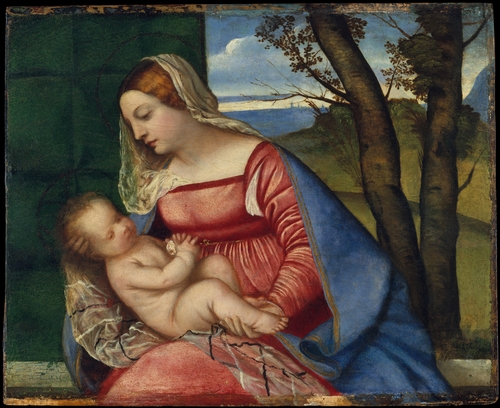
While Florence and Rome dominated the Renaissance with their quest for classical ideals, Venice developed a distinct pictorial tradition in which color played an absolute role. Titian Vecellio (1488/90-1576) took blue to a new level, using it not only to evoke spirituality but also to intensify emotions and atmospheres.
An example of Titian‘s vibrant blue can be found in the Madonna of Ca’ Pesaro, where the Virgin’s mantle contrasts with the surrounding warm tones. His glazing technique—layers of translucent color—allowed him to create unparalleled effects of luminosity and depth, giving blue nuances and textures previously unimaginable.
Blue in the Baroque: Drama and Emotion
If during the Renaissance blue was synonymous with harmony and transcendence, in the Baroque period it took on a more dramatic and theatrical character. Artists like Domenichino (1581-1641) and Guercino (1591-1666) stood out for their use of blue, exploring its intensity to create vivid and emotional atmospheres. Domenichino used blue significantly in The Virgin of the Rosary (c. 1600-1605), where Mary’s blue mantle stands out in the composition, emphasizing her divine nature. Guercino, in The Virgin with Child and Saints (1629), employs a vibrant blue in the Virgin’s garment, creating a strong contrast with the surrounding golden and earthy tones, intensifying the emotional depth of the scene.
Guido Reni (1575-1642), with his more classical approach within the Baroque, revived ultramarine blue in his religious works, reinforcing the link between the Renaissance tradition and the expressiveness of the new era.
Blue Beyond the Baroque: From Canaletto to the 20th Century
In the following centuries, the color blue continued to play an essential role in Italian painting. Canaletto (1697-1768), a master of Venetian vedute, used shades of crystalline blue to capture the light and unique atmosphere of Venice. His blue was not just a background but the protagonist of scenes where sky and water merge into a luminous spectacle, as seen in The Grand Canal in Venice.

Blue as a Timeless Symbol
From Giotto’s celestial blue to Canaletto’s crystalline luminosity, the color blue has traversed the centuries as an essential element of Italian painting. More than just a pigment, it has been a vehicle of transcendence, spirituality, and emotion, adapting to different artistic schools and styles throughout history.
Whether in the sacred depth of Renaissance Madonnas, the vibrant expressiveness of the Venetian palette, or the atmospheric luminosity of Canaletto’s landscapes, blue has remained a link between the visible and the invisible, between the human and the divine. And just as Italian art continues to be a worldwide reference, blue continues to exert its charm, remaining eternal in its symbolism and visual impact. This connection still resonates today.
Links
The surprising role of light blue in Italian national identity
Scrovegni Chapel
References:
Gombrich, E. H. The Story of Art
Pastoureau, Michel. Blue: The History of a Color

 ✍️ Idealizadora e autora do Verament...